


The compliance bar for Great Britain's EV charging market is far higher than many overseas suppliers realise. Since July 2022, every new private smart chargepoint sold and installed across England, Scotland and Wales must comply with the Electric Vehicles (Smart Charge Points) Regulations (EVSCP). This is not a premium add-on or marketing selling point. It is a legal requirement for residential and workplace chargepoints, the two highest-volume segments for importers and installers.
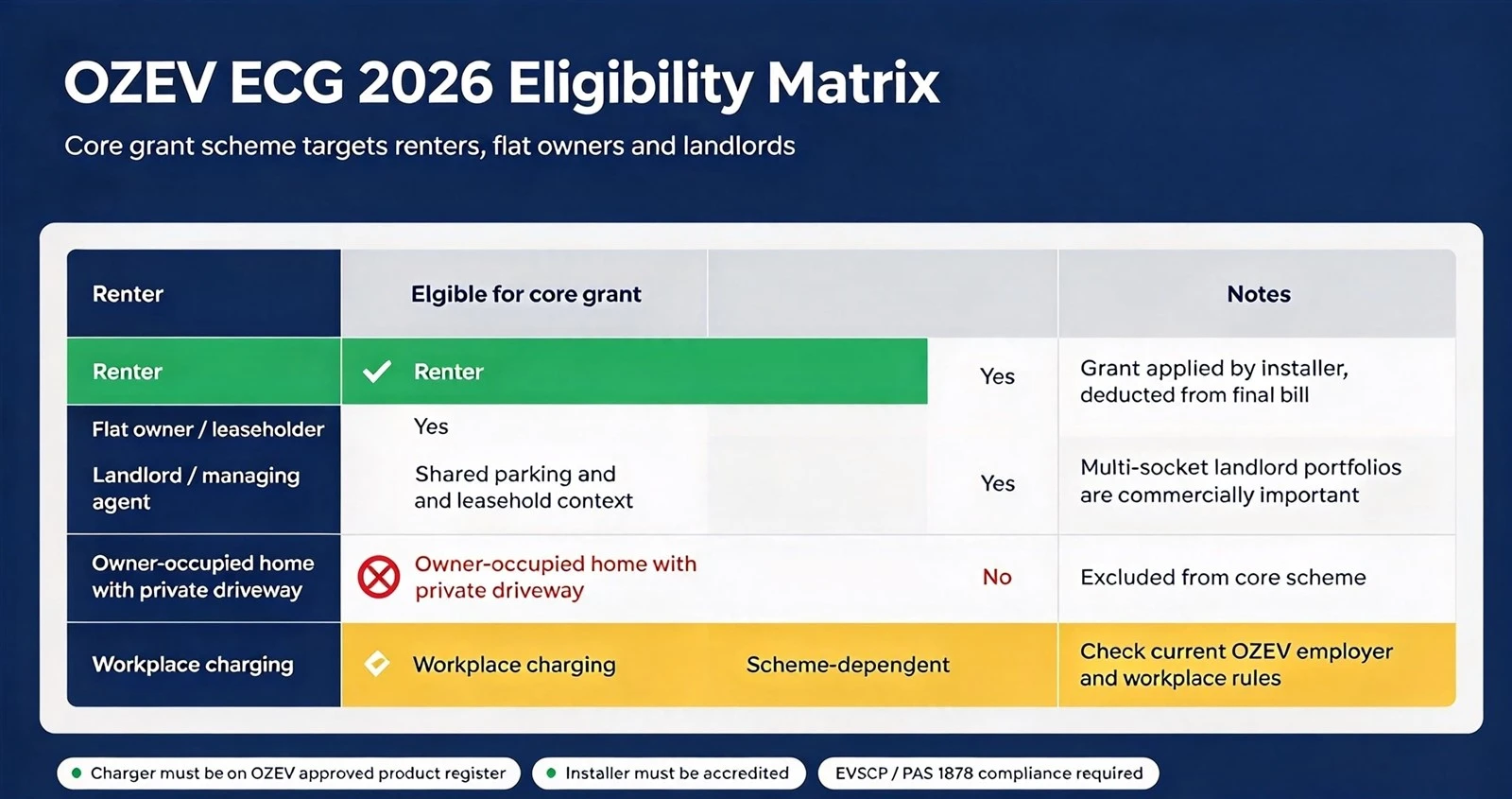
Important geographic note: These EVSCP, PAS 1878 and UKCA rules apply to Great Britain only. Northern Ireland operates under EU conformity rules and CE marking; this framework does not apply there.
What "Smart" Means Under UK Law
The regulation lays down hard functional rules, not just a vague requirement for Wi-Fi connectivity. A compliant chargepoint must connect online, support user scheduling, default to off‑peak charging, include encryption and data security controls, and accept remote firmware updates.
The default off‑peak behaviour trips up countless non-compliant imports. A charger that lets users set a schedule manually, but does not fall back to off‑peak by default, fails the regulation. The policy is designed to flatten national grid demand: drivers must actively override the off‑peak setting if they want to charge immediately.
A second non-negotiable firmware behaviour is the random start delay, capped at 600 seconds (10 minutes). This stops hundreds of chargers firing up at the exact same moment and creating sudden grid load spikes. An extended delay up to 1800 seconds is permitted as an optional grid-support function, but it is not required by law. This logic must be baked into firmware at development stage - it cannot be retrofitted by distributors or installers.
PAS 1878 and PAS 1879 are the BSI technical specifications that underpin the statutory rules. PAS 1878 defines device-level smart charging functions, security and architecture. PAS 1879 covers multi-device system interoperability and back-office integration.
For distributors, "PAS 1878 aligned" is a much more useful check than the loose label "smart charger". It references a testable standard, not just marketing wording.
Our wall-mounted chargepoints ship with factory firmware pre-configured for the GB market: default off‑peak logic, mandatory random delay, and feature sets mapped to PAS 1878 requirements. [Internal Link: Wall-Mounted EV Charger ]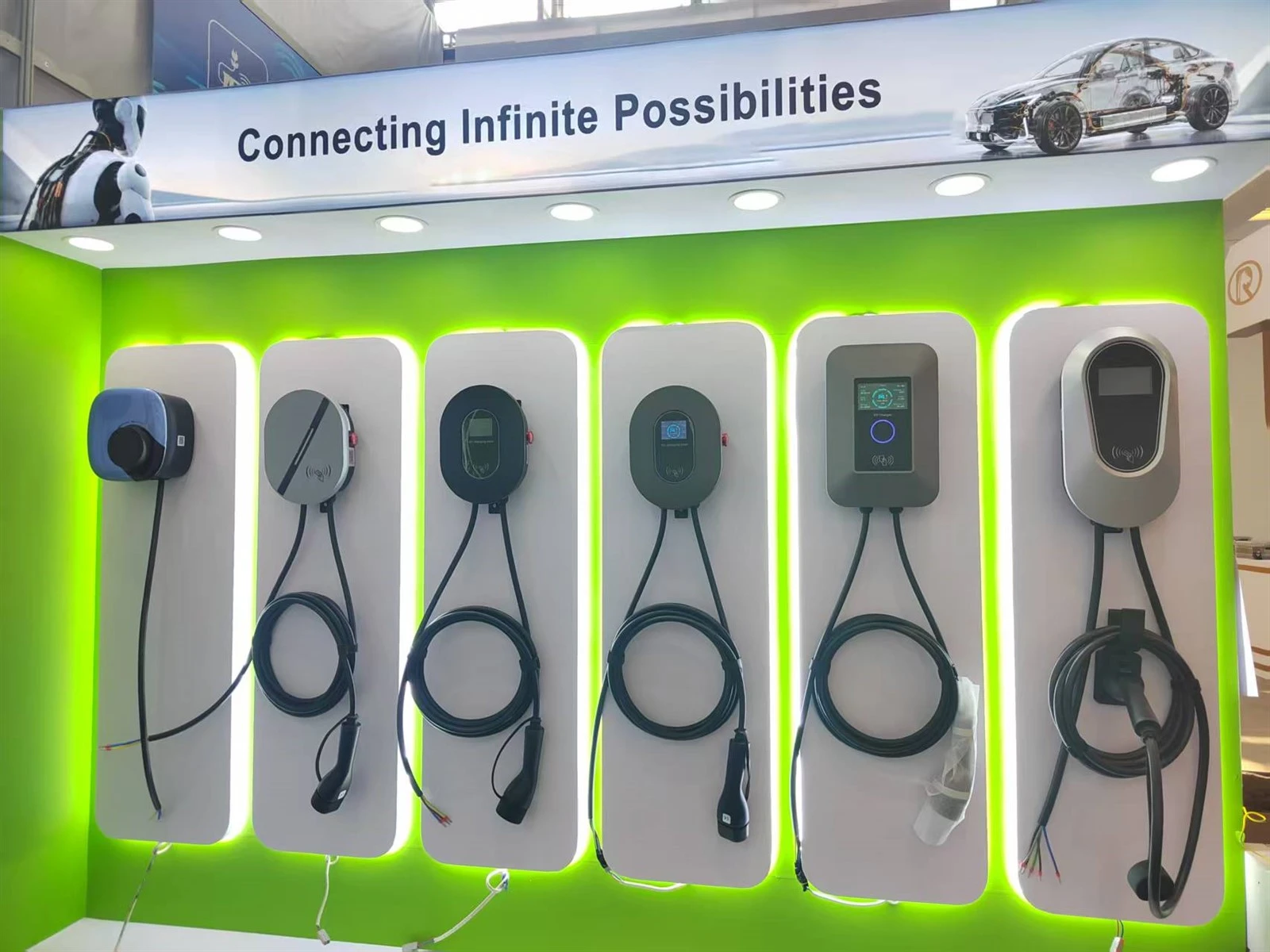
UKCA, Post-Brexit Conformity & PSTI Cybersecurity
UKCA is the mandatory conformity mark for Great Britain, replacing CE for chargepoints placed on the GB market. While some older stock or legacy project workflows still reference CE documentation, CE marking alone no longer satisfies the legal conformity requirement for new shipments.
For exporters already holding valid CE technical files, UKCA is often an incremental documentation exercise rather than a full retest - only when the technical construction file is complete. The biggest risk comes from treating GB as "EU charger plus a different plug". Installers and DNOs will reject units missing grid compatibility test records or cybersecurity documentation.
Separately, the PSTI (Product Security and Telecommunications Infrastructure Act) obligations for connected products are phasing in through 2026. Connected chargepoints must meet baseline cyber security requirements, with evidence held within your technical file.
OZEV ECG Grant: The Commercial Driver for Volume Projects
Starting 1 April 2026, the OZEV Electric Vehicle Chargepoint Grant (ECG) offers £500 per socket, covering up to 75% of equipment and installation cost. Claims are submitted by the accredited installer and deducted from the customer's final invoice.
A critical eligibility shift shapes your product strategy: owner-occupied homes with private driveways are excluded from the core grant. The funding pool is reserved for renters, leasehold flat owners and landlords. That means grant-backed volume sits almost entirely within multi-lease buildings, shared parking and property portfolios.
These buyers are not shopping for individual consumer wallboxes. Landlords and property managers care about per-socket costing, fleet-style group management, simple installation and traceability for grant claims. To support this use case, the charger must be eligible for OZEV registration and support per-socket claim workflows. Tethered / untethered design, single or three-phase rating are compliance and commercial decisions, not cosmetic choices.
We support customers preparing OZEV registration packs, multi-unit fleet management firmware and project documentation tailored for UK landlords and shared parking deployments.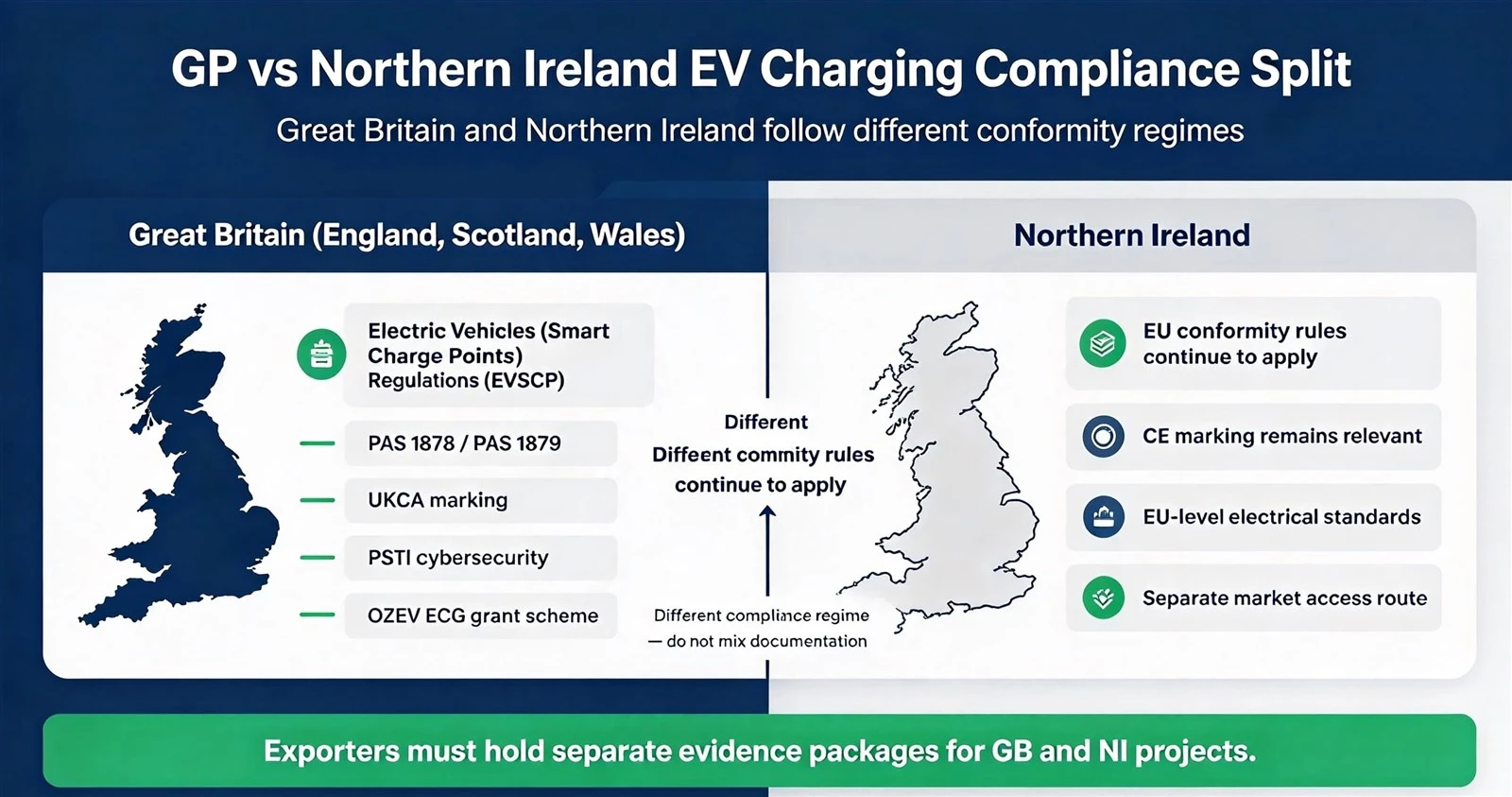
The UK Market Split
Like Germany, the UK cannot be treated as one uniform market, though the segmentation works differently:
Owner-occupier private homes: No OZEV grant, but the charger still legally needs full EVSCP smart functionality.
Flats, rental blocks and landlord portfolios: Grant-eligible, high-volume, multi-port managed deployments.
Workplace charging: Falls under the same EVSCP baseline rules, grant eligibility depends on scheme criteria.
The compliance floor is identical for all three groups: default off‑peak behaviour, mandatory random delay, secure connectivity and updatable firmware. No matter how good your connector or power rating is, a chargepoint missing these firmware features cannot legally enter GB's core sales channels.
For scenarios outside the fixed hardwired smart-chargepoint mandate - road trips, backup power and temporary use - our portable chargers offer adjustable current control without the full EVSCP firmware stack. [Internal Link: Portable EV Charger ]
Distributor Due-Diligence Checklist for UK GB Projects
Before quoting for UK deployments, run these checks with your supplier:
- Is the unit built to satisfy EVSCP statutory rules and PAS 1878?
- Can the firmware enforce default off‑peak charging + mandatory random delay up to 600s?
- Is the technical file ready for UKCA, and is PSTI cybersecurity evidence included?
- Can the model be registered on the OZEV approved product register if the project requires grant funding?
- Is the unit documented for DNO grid compatibility checks by UK installers?
FAQ
Q: Is a charger with app scheduling but no default off‑peak setting compliant?
A: No. The EVSCP regulations require default off‑peak behaviour, not just manual scheduling via an app. A user-controlled timer alone will not meet the legal requirement.
Q: What is the difference between PAS 1878 and PAS 1879?
A: PAS 1878 defines the device-level smart functions and security architecture for individual chargepoints. PAS 1879 addresses interoperability across multi-charger management systems. PAS 1878 is the primary specification you will be tested against.
Q: Can I claim the £500 OZEV grant for an owner-occupied house with a private driveway?
A: No. The core ECG grant targets renters, flat owners and landlords. Private owner-occupied driveways are excluded from the current scheme.
Q: Does UKCA fully replace CE for Great Britain?
A: Yes, UKCA is the required conformity marking for chargepoints newly placed on the GB market. CE marking alone is no longer accepted as legal conformity for new stock.
Q: Is the random delay requirement part of PAS 1878 or the smart charging regulations?
A: The random delay rule originates in the EVSCP statutory regulations and is mapped into PAS 1878. It must be implemented in firmware and cannot be added via external hardware.