


France differs fundamentally from Germany and the UK on one commercial rule that shapes your whole go-to-market strategy: subsidies do not attach to the charger product or the end buyer. They attach to the qualified installer. Once you grasp this, your pricing, documentation and channel strategy all shift.
A critical distinction most overseas exporters miss at the start: IRVE is an installer qualification, NOT a product certificate stamped onto the charger itself. No lab tests the charger for "IRVE approval"; the legal requirement sits with the company carrying out the installation.
IRVE: The Legal Gatekeeper Under Decree 2017-26
Under French Decree 2017‑26, any EV chargepoint rated above 3.7 kW must be installed by a professional holding valid Qualifelec IRVE certification. This is statutory, not an optional quality mark. Around 5,000 certified IRVE operators are active in France, split across three competency tiers:
- Level 1: Residential single-family installations
- Level 2: Tertiary / commercial multi-charger sites
- Level 3: DC fast-charging infrastructure
IRVE certification is valid for four years and requires formal electrical training, professional liability insurance and electrical authorisation. Crucially: to access ADVENIR subsidy and the former CIBRE tax credit, the installer must hold RGE status alongside IRVE. An IRVE-only installer cannot submit ADVENIR grant files.
Practically speaking: your customer can buy the charger, but if they cannot source an RGE+IRVE certified installer, they cannot legally commission >3.7kW hardware and cannot claim ADVENIR funding.
That changes the sales order of priority. The first question for France is not which distributor stocks your SKU - it is which IRVE installers will specify your charger on their quotes. Installers pick products primarily based on how much administrative work the unit creates, far more than marginal price differences.
Source: Qualifelec / CEE official RGE‑IRVE guidance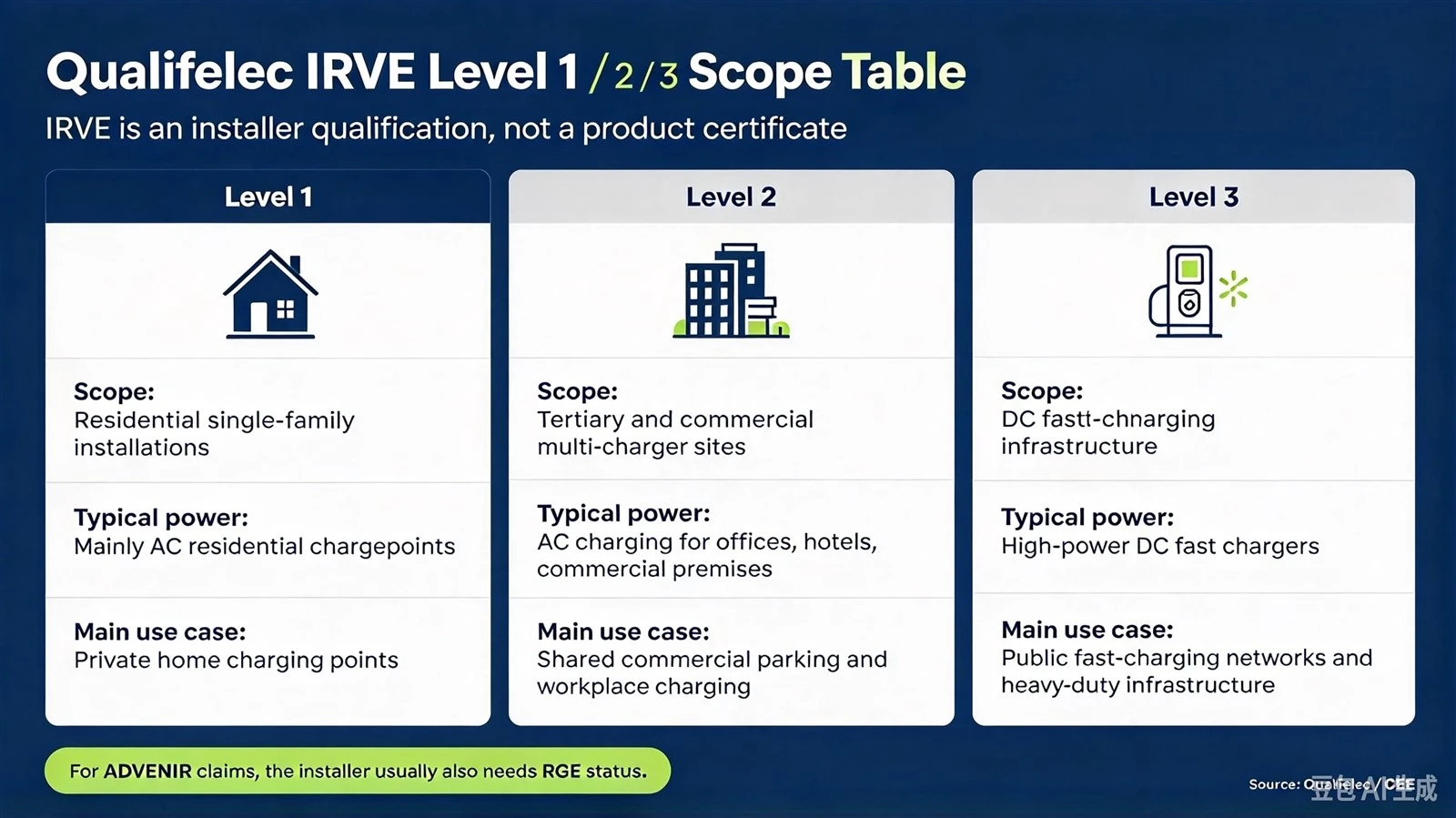
ADVENIR Prime Collective: 2026 Subsidy Framework
The ADVENIR programme runs through 2027. Its main funding stream, ADVENIR collectif, targets shared parking within collective residential buildings, not private detached garages. Eligible projects can receive up to €1,000 excl. VAT per charging point, covering 50% of qualifying hardware and installation costs. Larger site-level collective infrastructure grants are also available, scaled by the number of parking bays.
The installer owns the whole grant workflow. End users cannot submit ADVENIR applications themselves. The IRVE/RGE installer compiles the full dossier, submits it, and the subsidy is deducted directly from the final invoice. The installer carries all audit and documentation risk.
This creates a powerful product differentiator: a charger shipped with incomplete or machine-translated paperwork forces the installer to rebuild technical files from scratch. If you deliver a pre-packaged French-language documentation bundle - datasheets, DoC referencing applicable EN standards, pre-filled commissioning parameters and protection notes - you cut their admin burden dramatically. In this installer-controlled channel, paperwork readiness beats small price discounts.
Our wall-mounted chargers ship with ready-to-use French-language technical packs and commissioning reference sheets built for IRVE audit and ADVENIR dossier submission. [Internal Link: Wall-Mounted EV Charger ]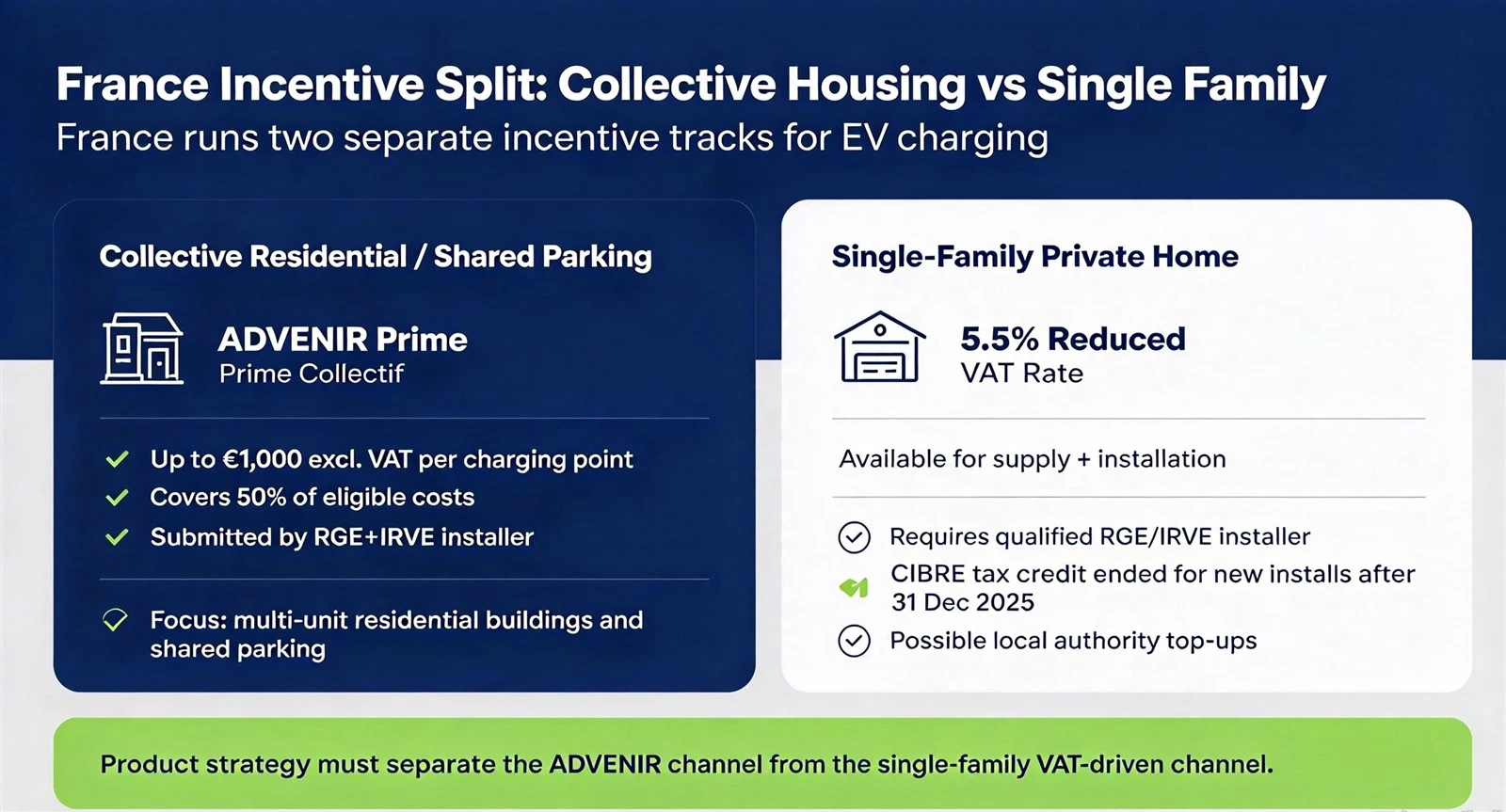
What the IRVE Installer Needs for Commissioning
Installers are audited on traceable commissioning evidence, not marketing brochures. For every site, they must document:
- Correct upstream protection: Type A or Type B RCD, selected based on local TN-S / TN-C-S earthing scheme
- Earthing compatibility matching the charger design
- Recorded test values and configuration settings
Trouble arises when the technical file buries protection requirements inside generic English manuals, leaving installers to hunt for DIP-switch or firmware settings. A concise installer one‑pager listing required protection, power configuration and test points speeds up site handover and makes your charger their default choice for future quotes.
This is a relatively light documentation project, but it separates products that sit forgotten in distributor catalogues from products that appear repeatedly on IRVE quotes.
We offer custom French labelling, installer commissioning packs and tailored documentation packaging for OEM/ODM projects targeting the French market.
Two Separate French Market Tracks
ADVENIR collective funding is reserved for shared residential parking. Single-family homes with private garages follow a completely different incentive structure. The old CIBRE residential tax credit ended for installations paid after 31 December 2025. For 2026, the main fiscal incentive for single-family installs is the 5.5% reduced VAT rate, again only available when fitted by an RGE/IRVE qualified installer. Local council top-up grants may apply regionally but are not a national scheme.
That means France operates in two distinct lanes:
Collective residential / shared parking: ADVENIR-backed, installer-gated, documentation-heavy
Single-family private home: 5.5% VAT incentive, price-sensitive, no ADVENIR collective eligibility
Treating France as a single homogeneous market wastes effort and mispositions your SKUs.
For private residential use, road trips and backup charging where ADVENIR collective rules do not apply, our portable EV chargers offer flexible adjustable-current charging. [Internal Link: Portable EV Charger ]
Distributor & Installer Due-Diligence Checklist for France
- Before quoting French projects, validate these points with your charger supplier:
- Does the charger carry full CE conformity (LVD / EMC / RED / RoHS)? MID documentation if kWh billing is required?
- Is French installer-facing documentation available, including protection notes and commissioning sheets?
- Are RCD and earthing requirements clearly stated for TN‑S / TN‑C‑S French grid configurations?
- Can the documentation package be directly inserted into an ADVENIR grant dossier by an RGE+IRVE installer?
- Is there local technical support available for IRVE installer commissioning queries?
FAQ
Q: Is IRVE certification required on the charger itself?
A: No. IRVE is a qualification held by the installation company/technician, not a product certificate for the EV charger. Installations above 3.7 kW must be completed by IRVE-qualified staff.
Q: Can the homeowner apply for ADVENIR subsidy directly?
A: No. The RGE+IRVE certified installer prepares and submits the ADVENIR dossier, and the subsidy is deducted from the installation invoice.
Q: What replaced the CIBRE tax credit for home chargers in 2026?
A: The CIBRE tax credit closed for new installations after 31 Dec 2025. The primary national incentive for single-family homes is the 5.5% reduced VAT rate, subject to installation by a qualified RGE/IRVE installer.
Q: Do I need French-language documents to sell chargers in France?
A: There is no blanket legal rule forcing every document into French. However, safety instructions, commissioning guides and technical notes must be usable by IRVE installers. In commercial practice, French documentation is essential for ADVENIR grant workflows.
Q: Is ADVENIR prime available for single-family private garages?
A: The core ADVENIR collective subsidy targets shared parking in multi-unit residential buildings. Standard detached private garages are outside this scheme and rely on 5.5% VAT and possible local grants.