


Germany's federal LIS‑MPH grant programme opened 15 April 2026 with a total budget of up to €500 million for charging infrastructure inside and around multi‑family residential buildings. Critically, this subsidy does not only provide capital support: it sets clear hardware thresholds that define viable products for Germany's multi‑dwelling marketNationale .
Grant per parking‑space summary
- €1 300: Pre‑cabling only, no charging point installed
- €1 500: Pre‑cabling plus 11‑22 kW charging point
- €2 000: Pre‑cabling plus bidirectional charging point
Basic programme eligibility rules: The building must contain minimum three residential dwelling units. Projects need either pre‑cabling for at‑least 20 % of all parking spaces OR at‑least six fully‑electrified parking bays. Only building owners, housing associations (WEG), and landlords can submit applications; individual tenants are not eligible. Application deadline is 10 November 2026. Funding is allocated on a first‑come‑first‑served (Windhundprinzip) basis; the budget may become fully exhausted before the formal closing date.
Source: Nationalen Leitstelle Ladeinfrastruktur official LIS‑MPH programme documentation.
Core Hardware Eligibility Constraints Imposed by LIS‑MPH
To qualify for LIS‑MPH, your hardware must satisfy real‑world multi‑family operating constraints beyond raw power rating: 11‑22 kW output, smart load‑management capability, and appropriate billing functionality.
Important distinction for Eichrecht compliance:
Dedicated single‑user parking spot (one fixed resident per charger): Eichrecht PTB metering is NOT mandatory.
Shared parking space with cross‑user kWh billing: PTB‑certified Eichrecht metering becomes compulsory.
A charger without compliant multi‑user billing capability cannot be used for shared multi‑dwelling projects, no matter its power rating. Equally, without multi‑port dynamic load modulation, hardware creates operational risk when six or more EVs charge simultaneously within one building.
Three Segments of the German EV Charger Market
Germany cannot be treated as a single homogeneous market; buyers need to separate three distinct use‑cases with different regulatory obligations:
- Single‑family private homes: Eichrecht metering is usually not required. §14a EnWG dry‑contact grid‑curtailment hardware is often optional, subject to local DNO rules.
- Multi‑family / multi‑unit residential buildings: Mixed rules apply. Shared‑billing deployments demand PTB‑listed Eichrecht metering. §14a EnWG requirements vary depending on the local distribution‑network operator. LIS‑MPH subsidy eligibility adds further hardware prerequisites.
- Commercial and fleet depots: §14a EnWG dry‑contact control‑input for grid curtailment is broadly expected. Eichrecht‑compliant metering is mandatory for any bill‑able charging service.
One single hardware SKU cannot satisfy regulatory requirements across all three market segments.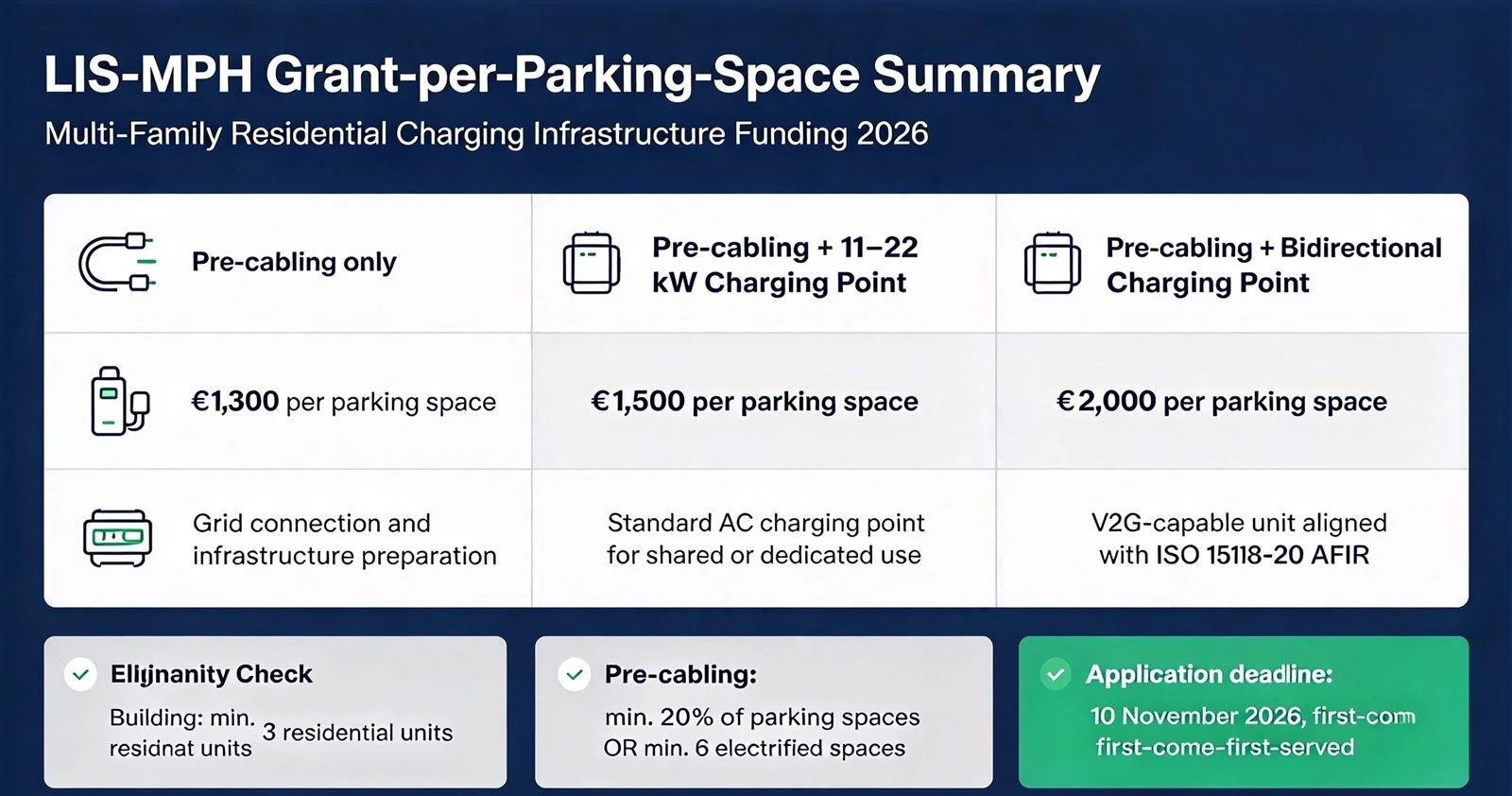
Distributor Due‑Diligence Checklist for German Projects
Before quoting for German deployments, distributors should ask these critical hardware‑qualification questions:
- Does the wallbox offer a PTB‑listed metering variant if shared‑user kWh billing will be required?
- Does the hardware support §14a EnWG requirements, either via dry‑contact control‑input or DNO‑accepted alternative implementation?
- Can firmware deliver cryptographically‑signed kWh transaction data to satisfy Eichrecht audit requirements?
- Is the unit eligible for LIS‑MPH subsidy scheme (check against Nationalen Leitstelle Ladeinfrastruktur product register)?
If any item cannot be satisfied, the product's addressable German market will be significantly narrower than its nominal power‑specifications suggest.
For single‑family homes, emergency scenarios and non‑billing deployments where Eichrecht compliance does not apply, our portable EV chargers deliver adjustable‑current capability without the overhead of calibrated metering hardware. For multi‑family and commercial fixed‑installation projects review our wall‑mounted and industrial‑grade charging hardware.
Disclaimer: This article offers market‑guidance for distributors only. It does not constitute legal or regulatory compliance advice. Final subsidy eligibility and technical obligations are determined by the Nationalen Leitstelle Ladeinfrastruktur and your local German distribution‑network‑operator(DNO). Rules are subject to official programme updates.
FAQ
Q: What is LIS‑MPH?
A: LIS‑MPH is Germany's federal €500 million grant programme for charging‑infrastructure retrofits within multi‑family residential buildings, open from April 15 2026 until November 10 2026, subject to budget exhaustion.
Q: Do I always need Eichrecht PTB metering for LIS‑MPH projects?
A: No. PTB‑certified Eichrecht metering is mandatory only for shared parking‑spots with cross‑user kWh‑billing. Dedicated single‑resident parking bays within multi‑family buildings do not require Eichrecht hardware to claim the subsidy.
Q: Does every multi‑family LIS‑MPH installation require §14a EnWG dry‑contact hardware?
A: Not universally. §14a EnWG grid‑curtailment requirements are set locally by each distribution‑network‑operator. Some DNOs accept alternative communication implementations instead of physical dry‑contact inputs. Always confirm requirements with the local grid‑operator prior to project tendering.
Q: What hardware do I need for the €2 000 bidirectional LIS‑MPH grant tier?
A: To claim the €2 000 per‑spot bidirectional charging subsidy, your charger hardware must support ISO 15118‑20 AFIR bidirectional‑charging functionality.